IPv6 is the latest version of the Internet Protocol for a larger address space, improved routing efficiency, and better end-to-end connectivity. These are features that are increasingly critical as IPv4 space continues to dwindle.
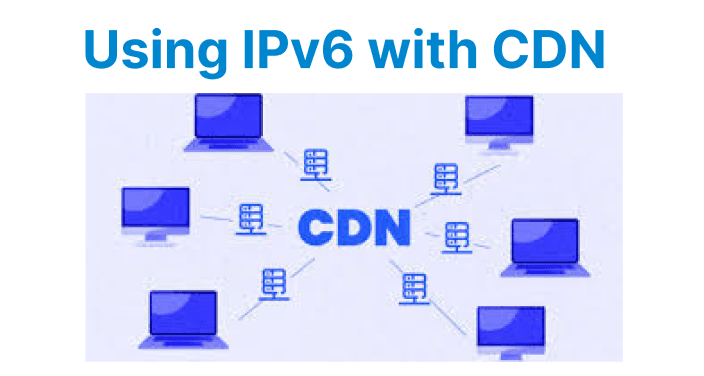
Content Delivery Networks (CDNs) (which distribute web and video content on geographically distributed edge nodes) must support IPv6 to remain accessible to modern clients and to avoid performance bottlenecks introduced by IPv4 workarounds.
Why IPv6 Matters for CDN Integration
Expanding Client Reach
Many mobile networks (especially in Asia, Africa, and parts of the United States) use IPv6-only configurations. Devices on these networks cannot reach IPv4-only CDN edge nodes without mechanisms like NAT64 or DNS64 to introduce latency, increase DNS resolution times, and degrade video quality.
Improved Routing Paths
IPv6 often results in shorter and cleaner routing paths due to the absence of NAT traversal. This is beneficial for video streaming, live broadcasts, and gaming content. Direct connections lower round-trip times and improve Quality of Experience (QoE).
Address Exhaustion and NAT Overhead
IPv4 exhaustion has led to shared addressing and widespread use of Carrier-Grade NAT (CGNAT). Consequences include port exhaustion on high-traffic sessions, increased jitter, and Double NAT scenarios that impact live or long-duration streaming.
CDN Provider Capabilities and IPv6 DNS Setup
CDN Support for IPv6
Most modern CDN providers like Cloudflare, Akamai, Fastly, AWS CloudFront, and Google Cloud CDN support IPv6. However, the degree of control over IPv6 behavior varies between services.
| CDN Provider | IPv6 Default Support | Configurable Behavior | Dual-Stack Support |
| Cloudflare | Enabled by Default | Yes | Yes |
| AWS CloudFront | Optional | Yes | Yes |
| Fastly | Enabled by Default | Limited | Yes |
| Akamai | Configurable | Yes | Yes |
DNS Configuration for IPv6
To make your CDN resources accessible over IPv6, you need to publish AAAA records (the IPv6 equivalent of A records):
video.example.com. 300 IN AAAA 2606:4700:10::6814:3dEnsure your origin server supports IPv6, or use dual-stack bridging, where the CDN edge serves IPv6 while connecting to your origin over IPv4.
IPv6 Benefits for Video Delivery
Lower Latency
Mobile clients connecting over IPv6 often experience fewer retransmissions, better initial throughput, and smoother playback for adaptive bitrate streaming (ABR).
Faster Connection Setup
Protocols like HTTP/2 and QUIC benefit from IPv6 by reducing handshake overhead. This minimizes video startup time and improves time-to-first-frame (TTFF).
Reduced NAT Complexity
Eliminating IPv4 NAT removes bottlenecks such as port exhaustion during high concurrency and connection tracking failures during long-lived video sessions or live streams.
Verifying IPv6 CDN Access
DNS Check
Use dig to inspect AAAA records:
dig AAAA video.example.comForce IPv6 Client Request
Use curl to confirm connectivity:
curl -6 https://video.example.comIf the response is successful and matches the IPv4 version, IPv6 is functioning correctly.
Operational Monitoring and Troubleshooting IPv6 CDN Delivery
Logging and Metrics
To monitor IPv6 usage, start by checking your CDN access logs. These logs should show which clients are connecting using IPv6 addresses. This helps you verify that IPv6 is actively being used in production. Make sure your observability or logging system can clearly distinguish between IPv4 and IPv6 traffic, so you don’t mix them up. It’s also useful to track how much of your traffic is IPv6-based and see how this varies across different regions, networks, or devices. This data helps you optimize CDN configurations and prioritize performance improvements for high-IPv6 regions.
Connectivity Tracing
To troubleshoot IPv6 routing issues, you can use tools like traceroute and mtr in IPv6 mode. These tools help you visualize the path IPv6 packets take from a client to the CDN edge node. This is useful for detecting problems like route detours, excessive hops, or ISP misconfigurations that cause latency or instability. Use the following commands to perform IPv6-based path tracing:
traceroute -6 video.example.commtr -6 video.example.comThe -6 flag ensures that the tool uses IPv6 rather than defaulting to IPv4. If you see unexpected paths or timeouts in the output, it may indicate poor peering, regional misrouting, or even blackholing by intermediate networks. These insights are valuable for working with CDN vendors or ISPs to improve routing performance.
Packet Inspection and Analysis
For deeper troubleshooting, inspect live traffic using tools like tcpdump or Wireshark. Running sudo tcpdump -i eth0 ip6 lets you capture IPv6 packets on the server’s network interface. While reviewing the traffic, check if IPv6 headers are properly formatted and whether key packets like ICMPv6 (used for Path MTU Discovery) are reaching the server.
Dropped ICMPv6 packets can prevent large packets from being delivered correctly, leading to fragmentation or failed transfers. If you're seeing excessive packet loss or malformed packets, it’s likely a sign of network misconfiguration or filtering issues that need to be fixed.
Security Considerations for IPv6 in CDNs
Stateless Addressing
IPv6 devices use a method called Stateless Address Autoconfiguration (SLAAC) to assign their IP addresses. This means a single device can frequently change its IPv6 address, making it harder to track or block based on IP alone. If your security tools rely heavily on fixed IP addresses for filtering or logging, they may not work as effectively with IPv6.
No NAT ≠ No Security
Unlike IPv4, IPv6 doesn’t use NAT (Network Address Translation). That doesn’t make it less secure; it means you need to be more careful with your firewall settings. Every IPv6 address can be reached from the internet, so you have to set rules to allow or block traffic. Also, ensure your CDN’s security tools (like firewalls and bot protection) work the same way for IPv6 as they do for IPv4.
DDoS Protection
Most enterprise-grade CDNs offer DDoS protection for IPv6, but you should confirm that your plan includes it. Check that IPv6 traffic is being monitored and that it’s covered by the same detection thresholds and mitigation rules as IPv4 traffic. Also, make sure your CDN or third-party DDoS service uses IPv6-aware IP reputation and geolocation services. Hence, attackers can't bypass detection by switching IP versions.
How IPv6 Works with CDNs
When a CDN supports IPv6, its edge nodes are assigned both IPv4 and IPv6 addresses. Client devices that support IPv6 will request content using AAAA DNS records to resolve the CDN’s IPv6 edge infrastructure. This allows content to be delivered over IPv6 without relying on translation layers like NAT64 or DNS64.
The CDN serves cached content (such as HTML, JavaScript, images, or video chunks) from the nearest IPv6-enabled edge location. If the requested content is not cached, the edge server fetches it from the origin, either over IPv6 or IPv4, depending on how the origin is configured. This is known as dual-stack bridging, where the CDN edge communicates with IPv6 and IPv4 origins as needed.
IPv6 CDN delivery reduces address translation overhead, improves routing stability, and supports modern protocols like HTTP/2 and QUIC. To ensure full IPv6 functionality, you must configure DNS with AAAA records, and the origin server must support IPv6 directly or allow IPv6 access through the CDN’s bridging mechanism.