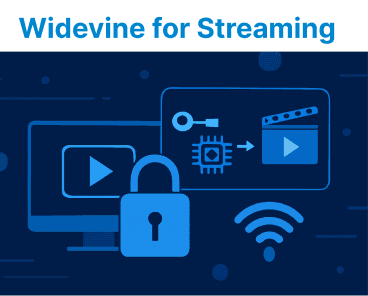
Widevine is a Digital Rights Management (DRM) that protects video content during live streaming. It secures key exchange, streams encryption, and license acquisition in real time for authorized devices. The workflow involves content encryption using Common Encryption (CENC), license delivery through a Widevine License Server, and client-side decryption integrated into video players.
Live streaming scenarios require additional considerations such as segment-based encryption, real-time manifest updates, and low-latency license responses. Widevine supports MPEG-DASH and HLS with CMAF for compatibility across multiple platforms and devices.
Key Components in a Widevine Live Streaming Workflow
Live Encoder
Encodes raw video input into a compressed format suitable for adaptive streaming by using H.264 or H.265. Encoders segment the live feed into short media chunks (e.g., 2 to 6 seconds) and prepare multiple bitrate renditions for ABR (Adaptive Bitrate) delivery.
Packager with CENC Encryption
Encrypts the video segments using Common Encryption (CENC) and packages them into Common Media Application Format (CMAF) containers or MPEG-DASH format. The packager integrates encryption keys, signaling metadata, and license acquisition URLs into the manifest files.
DRM Key Provider and License Server
A DRM provider generates encryption keys and hosts a license server. The license server issues keys to the packager during encryption, validates license requests from clients at playback, and enforces rules such as output control and security level requirements.
Origin Server or CDN
Encrypted segments and manifests are uploaded to an origin server or directly pushed to a CDN. These components must support low-latency segment delivery and cache control for time-sensitive playback.
Video Player with EME Support
Requests manifest files and media segments, initiates DRM license acquisition from the Widevine license server, and handles decryption and playback. The player must integrate with a Widevine-compatible Content Decryption Module (CDM) to process protected streams.
Working Mechanism of Widevine for Live Streaming
Content Preparation and Encryption
Before a live stream is broadcast, the raw video is segmented into chunks. Then, each video segment is encrypted using Common Encryption standards. Widevine supports AES-128 CTR and CBCS encryption modes. But it depends on the security level required.
During encryption, a unique content key is generated for each title or session. This key is stored securely in the Widevine license server. Encryption metadata (including key IDs and initialization vectors) is embedded in the manifest file.
License Acquisition Setup
The video player used for playback is integrated with a Content Decryption Module (CDM), a component of the browser or device platform. When playback is initiated, the player parses the manifest, extracts key IDs, and triggers a license request to the Widevine License Server.
This request includes the key ID, device-specific identifiers, DRM policies, and optional authentication tokens or session data. The request is signed or encrypted depending on the client’s security level (L1, L2, or L3).
License Delivery and Session Initialization
The Widevine License Server authenticates the request and responds with a license containing the content decryption key(s), playback policies, and license duration or expiration times. These licenses are encrypted and can only be interpreted by the CDM on the authorized device. This ensures that even if the license is intercepted, it cannot be reused elsewhere.
Real-Time Decryption and Playback
Once the license is received, the CDM initializes the secure decryption session. As video segments are downloaded, they are passed to the CDM, which decrypts them in-memory and forwards them to the secure video pipeline. No decrypted video data is accessible to external applications or the OS in L1 environments.
Widevine ensures compliance with real-time constraints by optimizing the decryption pipeline and buffering strategy. Any delay in license delivery or key validation can interrupt playback. So, the process is optimized to start streaming as soon as the initial license is validated.
Session Management and Policy Enforcement
During playback, the CDM continues to enforce policies received in the license. This includes blocking high-resolution output on unauthorized devices, refreshing licenses if required, and preventing screen recording or HDMI output if HDCP is not supported.
If the session violates any policy or the license expires, playback is halted, and the player displays an error or fallback stream. This layered architecture allows Widevine to secure live video streams in real time while meeting the performance demands of modern streaming platforms.
Tokenization and Playback Authentication
Live streams often require access control beyond encryption. These mechanisms ensure that authorized users obtain decryption keys and watch the live stream. Widevine workflows commonly integrate:
Signed URL Tokens: Generated by the backend for each session that is tied to the user, device, and timestamp.
Playback Authorization Tokens: JWTs or opaque tokens passed during license requests to the Widevine license server for user/device validation.