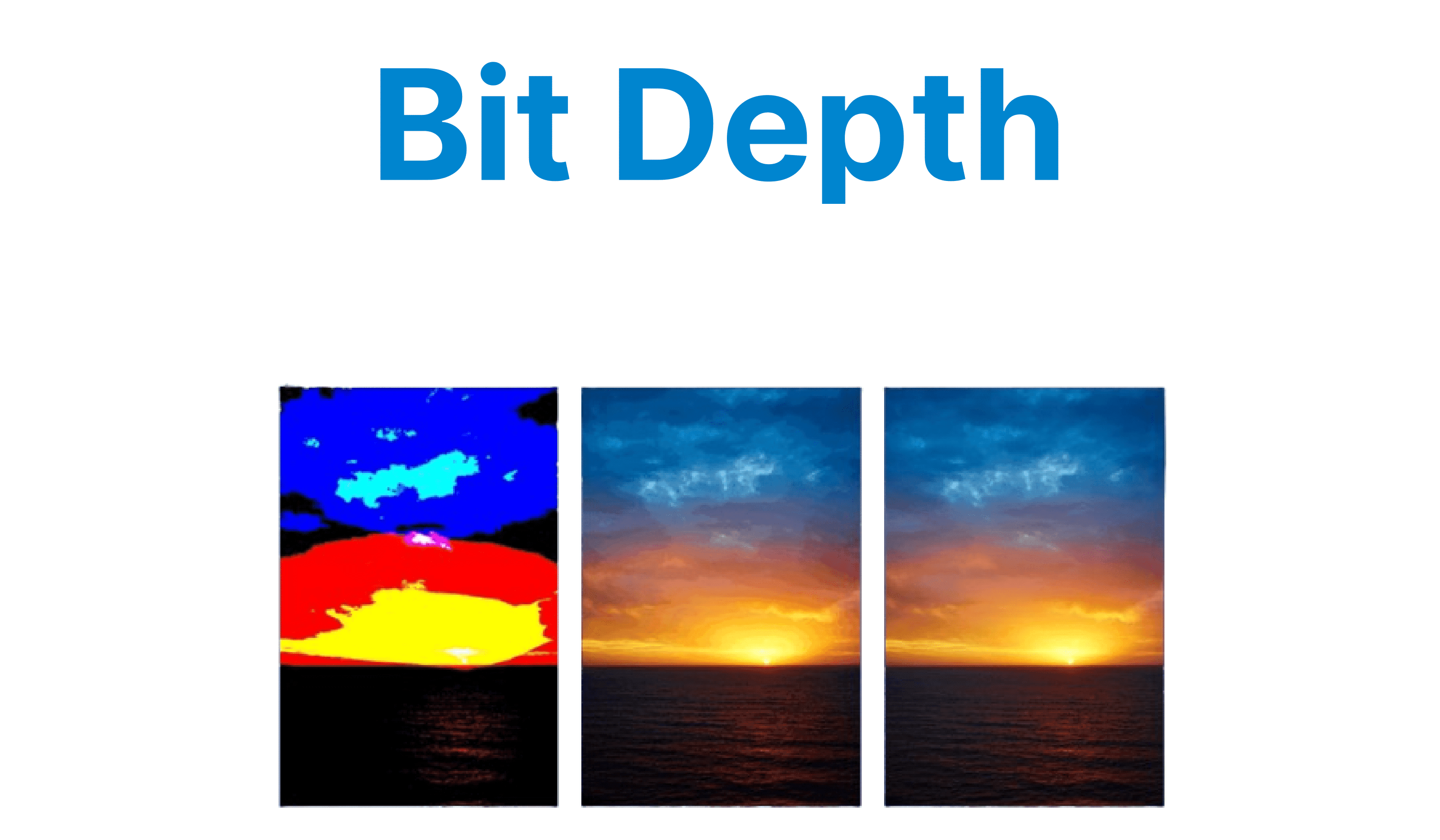
Bit depth refers to the number of bits used to represent color information for each pixel in a video. It directly affects the precision of color gradations and the total number of colors that can be displayed.
8-bit Video
8-bit is the most common bit depth used in standard video content, including web videos, SDR broadcasts, and consumer video formats.
Color Values per Channel
Each RGB channel uses 8 bits, allowing 256 distinct levels (0"255). This limits the precision of color representation, especially in smooth gradients.
Total Colors
The full RGB space supports 256 ?? 256 ?? 256 = 16,777,216 colors. While sufficient for basic visuals, this is inadequate for high-fidelity color work, especially in HDR.
Encoding
Widely used with H.264/AVC and MPEG-4 codecs. Typical 4:2:0 chroma subsampling is used to further compress data, which reduces color resolution.
File Size
Due to 8 bits per channel and the common use of 4:2:0 subsampling, file sizes remain low. Suitable for streaming and storage-limited scenarios.
Hardware Support
Supported by almost all modern and legacy playback devices, including web browsers, mobile phones, smart TVs, and set-top boxes. 8-bit video is the standard for SDR video and is used for general-purpose video delivery.
It's commonly found in SD content, DVDs, and streaming platforms that don't require high color precision. The visual quality is sufficient for most applications where extreme color accuracy is not a necessity.
10-bit Video
10-bit video increases color precision significantly and is widely adopted in HDR formats and professional-grade content.
Color Values per Channel
Each channel stores 1024 values (0"1023), enabling finer encoding of subtle tones and transitions, especially in skies, shadows, and skin tones.
Total Colors
Supports 1,073,741,824 colors, drastically reducing quantization error. This higher granularity is critical in HDR workflows
Encoding
Compatible with HEVC (H.265), VP9 Profile 2, and AV1. Often combined with Rec. 2020 color primaries and PQ or HLG transfer functions in HDR10 and HDR10+.
File Size
Approximately 25"30% larger than equivalent 8-bit encodes at the same resolution and bitrate. Bitrate must be carefully balanced to prevent artifacts.
Hardware Support
Requires HDR-capable display hardware with proper EOTF handling. Decoders must support 10-bit depth and correct tone mapping for HDR playback.
10-bit is used in HDR streaming (e.g., Netflix HDR10 content), color grading workflows, and professional cameras. It minimizes color banding and maintains smooth gradients, especially in skies, shadows, and other subtle transitions.
12-bit Video
12-bit is used in high-end cinema and post-production pipelines that demand extreme color accuracy and depth.
Color Values per Channel
Each RGB channel supports 4096 values (0"4095), offering extremely high precision in tone curves, especially in logarithmic encoding.
Total Colors
With 4096?? = 68,719,476,736 possible combinations, 12-bit allows extremely fine tonal separation, ideal for wide gamut and high dynamic range grading.
Encoding
Used in high-end formats like ProRes 4444 XQ, Blackmagic RAW, and DNG sequences. Often delivered in log or RAW form to preserve maximum post-processing latitude.
File Size
Substantially larger than 8- and 10-bit files. Even with compression, storage requirements often exceed 1 Gbps for 4K content. Not suitable for streaming use cases.
Hardware Support
Requires professional cinema cameras (e.g., ARRI, RED, Blackmagic), high-precision monitoring (10-bit+ displays with DCI-P3 or Rec. 2020 coverage), and GPU acceleration for editing.
12-bit is primarily used in cinema production, archival formats, and workflows requiring extensive color manipulation in post-production. It allows for precise tone mapping, wide-gamut encoding, and high dynamic range preservation.
Comparison of 8-bit, 10-bit, and 12-bit Video
| Features | 8-bit | 10-bit | 12-bit |
| Color Values | 256 | 1024 | 4096 |
| Total Colors | ~16.7 million | ~1.07 billion | ~68.7 billion |
| File Size | Small | Large | Very Large |
| Color Banding Risk | High | Low | Minimal |
| Editing Flexibility | Limited | Moderate | High |
| Use case | SDR video | HDR content | Cinema, archival |