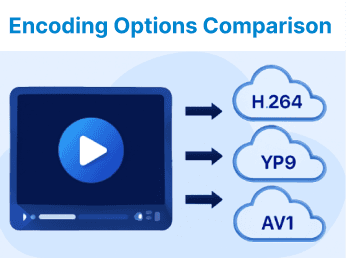
Video encoding is a foundational step in the delivery pipeline, converting source footage into adaptive, web-ready formats optimized for playback across varying devices and network conditions. SaaS-based platforms such as Cloudinary, Mux, JW Player, Brightcove, and Vimeo Enterprise offer distinct approaches to encoding, each with varying degrees of control over configuration, codec support, bitrate optimization, processing latency, and developer integration.
Platforms Compared
- Cloudinary — Transformation-centric platform with dynamic encoding and real-time delivery
- Mux — API-first video infrastructure with granular encoding control
- JW Player — Live and VOD-focused platform with simplified encoding and adaptive delivery
- Brightcove — Enterprise video platform with customizable ABR ladders and built-in analytics
- Vimeo Enterprise — Business-focused platform with preset encoding workflows and marketing tools.

Codec and Format Support
| Platform | Input Formats | Output Codecs | ABR Streaming |
| Cloudinary | MP4, MOV, WebM, MKV, AVI | H.264, H.265, VP9, AV1 (Beta) | HLS, DASH |
| Mux | MP4, MOV, TS, WebM | H.264, VP9 (AV1 in Roadmap) | HLS |
| JW Player | MP4, MOV | H.264, H.265 | HLS |
| Brightcove | MP4, MOV, WMV, AVI | H.264, H.265, VP9 | HLS, DASH |
| Vimeo | MP4, MOV, AVI | H.264 | HLS |
All platforms transcode uploaded content into adaptive bitrate (ABR) formats. Platforms like Cloudinary and Brightcove offer broader codec support and fallback handling for legacy devices.
Adaptive Bitrate (ABR) Profile Configuration
Cloudinary
Uses dynamic transformations to generate multiple resolutions on demand. Developers can configure automatic or manual ABR ladders using URL parameters.
<!-- Cloudinary ABR Example --> https://res.cloudinary.com/demo/video/upload/q_auto,f_auto,vc_h265/video.mp4Mux
Mux automatically generates multiple renditions per upload and exposes them through HLS playlists. Developers can customize encoding behavior using asset parameters.
curl -X POST https://api.mux.com/video/v1/assets \
-u YOUR_API_KEY: \
-H "Content-Type: application/json" \
-d '{
"input": "https://example.com/video.mp4",
"playback_policy": ["public"],
"per_title_encode": true
}'
JW Player
Automatically encodes video into 3–5 ABR renditions based on file resolution. No code-based control over bitrate tiers, but presets can be selected from the UI.
Brightcove
Offers custom ABR ladders and encoding profiles via API and dashboard. You can create and assign specific profiles with defined resolutions and bitrates.
{
"name": "HD_ABR",
"renditions": [
{ "format": "MP4", "height": 720, "video_bitrate": 2000 },
{ "format": "MP4", "height": 1080, "video_bitrate": 4000 }
]
}
Vimeo Enterprise
Uses fixed preset ladders optimized for business playback. No developer-facing configuration for bitrates or resolution tiers.
Encoding Performance and Latency
| Platform | Encoding Latency | Live-to-VOD Conversion | Instant Previews |
| Cloudinary | ~Seconds (On-Demand) | Yes (On Replay Request) | Yes |
| Mux | ~Seconds | Yes | Yes |
| JW Player | ~1–2 Minutes | Yes | Limited |
| Brightcove | 2–5 Minutes (Customizable) | Yes | Thumbnail Generation |
| Vimeo | 2–10 Minutes | Yes | Yes |
Mux and Cloudinary lead in terms of near real-time encoding, while JW Player and Brightcove offer faster-than-average encoding for larger file sizes with ABR packaging.
Developer Tooling and API Access
| Feature | Upload API | Transcoding API Control | Progress Notifications | Encoding Profiles |
| Cloudinary | Yes (Rest, Sdks) | Via URL / SDK | Webhooks | URL Params Or Presets |
| MUX | Yes (Rest) | Full Control Via Asset Config | Webhooks | Full Profile Support |
| JW Player | Yes | No Direct Control | No | Presets Only |
| JW Player | Yes | Profile-Based | Yes (Callback URL) | Fully Customizable |
| Vimeo Enterprise | Yes | No | No | Fixed |
Cloudinary and Mux provide fine-grained API control, enabling dynamic workflows and encoding logic. Brightcove offers more control than JW Player or Vimeo but favors enterprise-managed setups.
Real-Time Transformation and Re-Encoding
Cloudinary
Offers URL-based on-the-fly transformations for resolution, format, frame rate, and codec changes. Ideal for dynamically serving optimized assets per user.
https://res.cloudinary.com/demo/video/upload/e_loop,h_720,w_1280,vc_vp9/video.mp4Mux
Re-encoding is triggered via new asset uploads. There’s no transformation-by-URL model, but you can automate multiple versions using metadata and webhooks.
Brightcove, JW Player, Vimeo
Re-encoding requires manual re-upload or profile reassignment. No on-the-fly transformations supported.
DRM, Captions, and Accessibility
| Feature | DRM Support | Caption Support | Audio Normalization |
| Cloudinary | Via 3rd Party | VTT, SRT | Optional |
| Mux | No | VTT | Optional |
| JW Player | Widevine/Fairplay | VTT, SRT | Yes |
| Brightcove | Native DRM | VTT, SRT | Yes |
| Vimeo Enterprise | Enterprise-Only | VTT | No |
Brightcove and JW Player support end-to-end DRM workflows, while Cloudinary relies on external enforcement. Caption workflows are universally supported.
Use Case Recommendations
| Use Case | Recommended Platform |
| Developer-First Encoding Control | Mux or Cloudinary |
| Real-time Transformation | Cloudinary |
| Enterprise Video with DRM | Brightcove or JW Player |
| Simple Marketing Playback | Vimeo Enterprise |
| Custom ABR Profiles for OTT | Brightcove |
| High-Speed Upload and Encoding | Mux or Cloudinary |