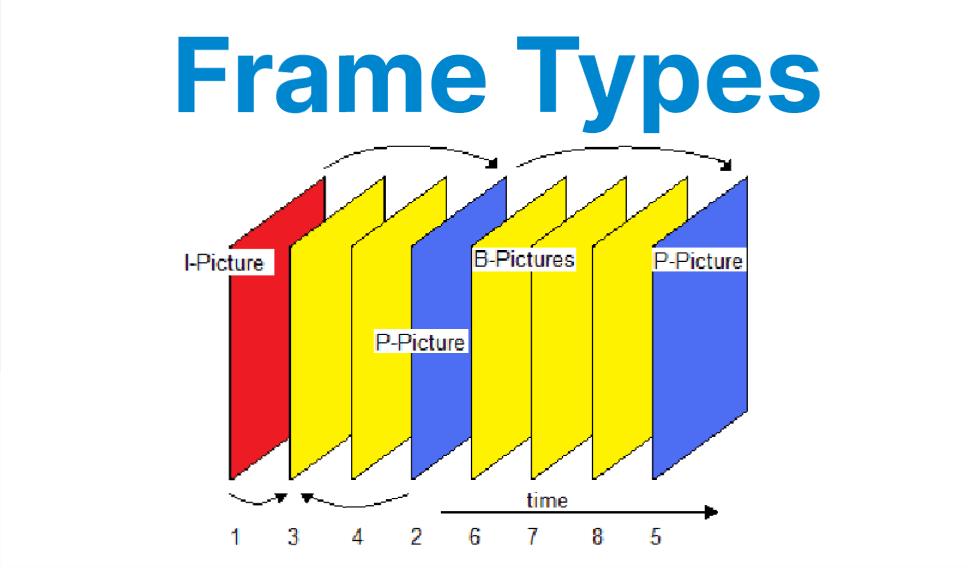
Video encoding compresses large sequences of video frames by using reference-based compression. Instead of storing every frame fully, modern codecs split the video into different frame types: I-frames (intra-coded), P-frames (predictive), and B-frames (bidirectionally predictive). Each plays a distinct role in balancing compression efficiency and decoding complexity.
I-Frame (Intra-Coded Frame)
An I-frame is a complete image frame that does not rely on any other frame for reconstruction. It serves as a reference point for decoding the frames that follow.
Technical Characteristics
I. Full Frame Data
I-frames include all pixel information necessary to display the frame independently. No prediction or referencing is used, which makes them significantly larger than P- or B-frames.
II. No Motion Prediction
There is no temporal prediction or motion vector computation. This makes I-frames computationally simpler to decode but heavier to store or transmit.
III. Independent Access
Since I-frames do not depend on any other frames. I-frames serve as entry points for seeking and are critical for functions like scrubbing, preview thumbnails, and stream switching.

For Development
I. Codec Behavior
Required by all codecs to allow random access during playback or scrubbing.
II. Usage
I-frames are inserted at scene changes or at fixed intervals to ensure decoders can resync in streaming scenarios.
III. Bitrate Trade-off
High I-frame frequency improves playback control but increases average bitrate. Fewer I-frames reduce bitrate but may affect stream resilience and seekability.
P-Frame (Predictive Frame)
P-frames store only the changes from the most recent preceding I- or P-frame using motion vectors and residuals. They require less space than I-frames by referencing previously decoded data.
Technical Characteristics
I. Delta Encoding
Stores only what has changed since the last reference frame. This includes motion vectors and pixel residuals.
II. Forward Prediction
P-frames can only refer to frames that appear earlier in the decoding sequence. They cannot use future frames for reference.
III. Reduced Size
By avoiding full image reconstruction and focusing only on differences, P-frames are smaller in size and offer better compression than I-frames.
For Development
I. Compression Efficiency
P-frames are the primary contributor to bitrate reduction in most video streams. Their performance depends on how stable and repetitive the content is across time.
II. Motion Estimation Accuracy
Quality depends on how well the encoder tracks object movement. Inaccurate motion vectors may introduce artifacts like ghosting.
III. Decoder Dependency
P-frames cannot be decoded on their own. They require the last I or P frame to reconstruct.
B-Frame (Bidirectional Predictive Frame)
B-frames are encoded using both previous and future reference frames (I or P). This dual reference allows for even higher compression efficiency.
Technical Characteristics
I. Bidirectional Prediction
Uses two references—one from a previous frame and one from a subsequent frame—to calculate motion compensation.
II. Smallest Size
Since B-frames can use more accurate references from both directions, they tend to have the lowest average bitrate among all frame types.
III. Higher Latency
The need to wait for both past and future frames makes B-frames less suitable for low-latency encoding.
For Development
I. Efficiency
B-frames offer superior bitrate savings and visual quality but come at the cost of memory and CPU usage. Ideal for offline or VOD encoding workflows.
II. Ordering
B-frames are encoded out of display order to allow backward reference. Encoders must manage reordering carefully to preserve the playback sequence
III. Trade-off
Not recommended for real-time or low-latency environments like video conferencing or live streaming due to the decoding delay they introduce.
Group of Pictures (GOP) and Frame Placement
A Group of Pictures (GOP) defines how I, P, and B frames are arranged in sequence. A typical GOP structure might look like
I B B P B B P B B ILength of GOP: Affects seekability and compression efficiency. Short GOPs: More I-frames, easier seek, larger file size. Long GOPs: Better compression, harder to edit.
What’s Next?
Want more control over how I, P, and B frames behave in your encoding setup? Use Cincopa's API to manage GOP structures, define keyframe intervals, optimize for playback performance, seek ability, and bandwidth efficiency