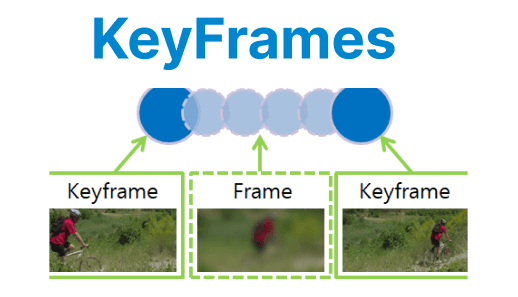
Keyframes, also known as I-frames (intra-coded frames), are complete image frames that serve as essential reference points in compressed video streams. Unlike other frame types (P-frames and B-frames), keyframes contain all the data needed to reconstruct the image independently.
Role of Keyframes in Video Compression
Keyframes are the starting points for compression cycles in most modern video codecs. They carry the entire image data for a frame, while all subsequent frames (P-frames and B-frames) store only motion vectors and pixel differences relative to these keyframes.
Their primary roles include
I. Reference Foundation for Predictive Frames
All predictive frames (P/B) rely on keyframes for motion estimation and compensation. A missing or poorly placed keyframe results in decoding failure or visual artifacts across the dependent frames in that GOP.
II. Compression Boundary Control
Keyframes reset the prediction chain and start a new compression block. This boundary allows encoders to contain temporal prediction within GOPs, which improves decoding speed and stream segmentation.
III. Optimization Anchor for Bitrate Control
In Constant Rate Factor (CRF) and Variable Bitrate (VBR) encoding, keyframes are used as control points to distribute bits more efficiently. More complex scenes may require denser keyframe placement to preserve detail.

How Keyframes Affect Video Compression
Keyframes carry the highest amount of data because they are not compressed with temporal prediction. This impacts
File Size
More frequent keyframes increase overall file size, as each I-frame consumes significantly more space than predicted frames.
Compression Efficiency
Fewer keyframes result in longer GOPs, allowing more P- and B-frames to reuse data from the last keyframe, leading to better compression ratios.
Encoding Time
Keyframes require more processing, especially at high resolutions, because they contain all pixel data without prediction shortcuts.
Encoding and Decoding Considerations
Keyframes require more CPU and memory resources during encoding since they are processed independently of temporal references. They are typically quantized less aggressively to maintain visual quality, serving as reference anchors for predicted frames. During decoding, keyframes enable consistent reconstruction and seek functionality. In live or low-latency streaming, insufficient keyframe frequency can cause recovery delays after packet loss, while excessive insertion increases bandwidth consumption unnecessarily.
Keyframe Extraction & Manipulation
Frame-Accurate Editing
Edits made directly on non-keyframes require re-encoding, which introduces a transcoding penalty. To avoid this, cuts should align with I-frames. Tools like ffmpeg can enforce keyframe placement during encoding.
ffmpeg -i input.mp4 -force_key_frames "expr:gte(n,5)" output.mp4Debugging & Analysis
To inspect keyframe placement and GOP structure during post-encoding validation:
- Keyframe Identification (using FFprobe):
ffprobe -show_frames -select_streams v input.mp4 | grep "pict_type=I"- Interval Verification: Use mkvinfo (for Matroska files) or mp4box -info (for MP4 files) to inspect GOP layout and keyframe spacing.
Keyframe Interval Strategy and GOP Design
The spacing between keyframes (keyframe interval or GOP length) directly affects compression performance, seekability, and visual stability.
- Short GOPs (e.g., 30 frames) improve seek precision and recovery speed after packet loss but increase bitrate overhead.
- Long GOPs (e.g., 120–300 frames) provide better compression but require stable network conditions and can degrade quality recovery time during streaming interruptions.
What’s Next?
Working with keyframe-driven workflows for streaming, editing, or compression? Use Cincopa’s API to manage keyframe placement, GOP structure, and scene detection thresholds during encoding. Whether you're optimizing for real-time streaming, seeking accuracy, or controlling bitrate, precise keyframe management improves decoding performance, stream reliability, and visual quality across delivery environments.