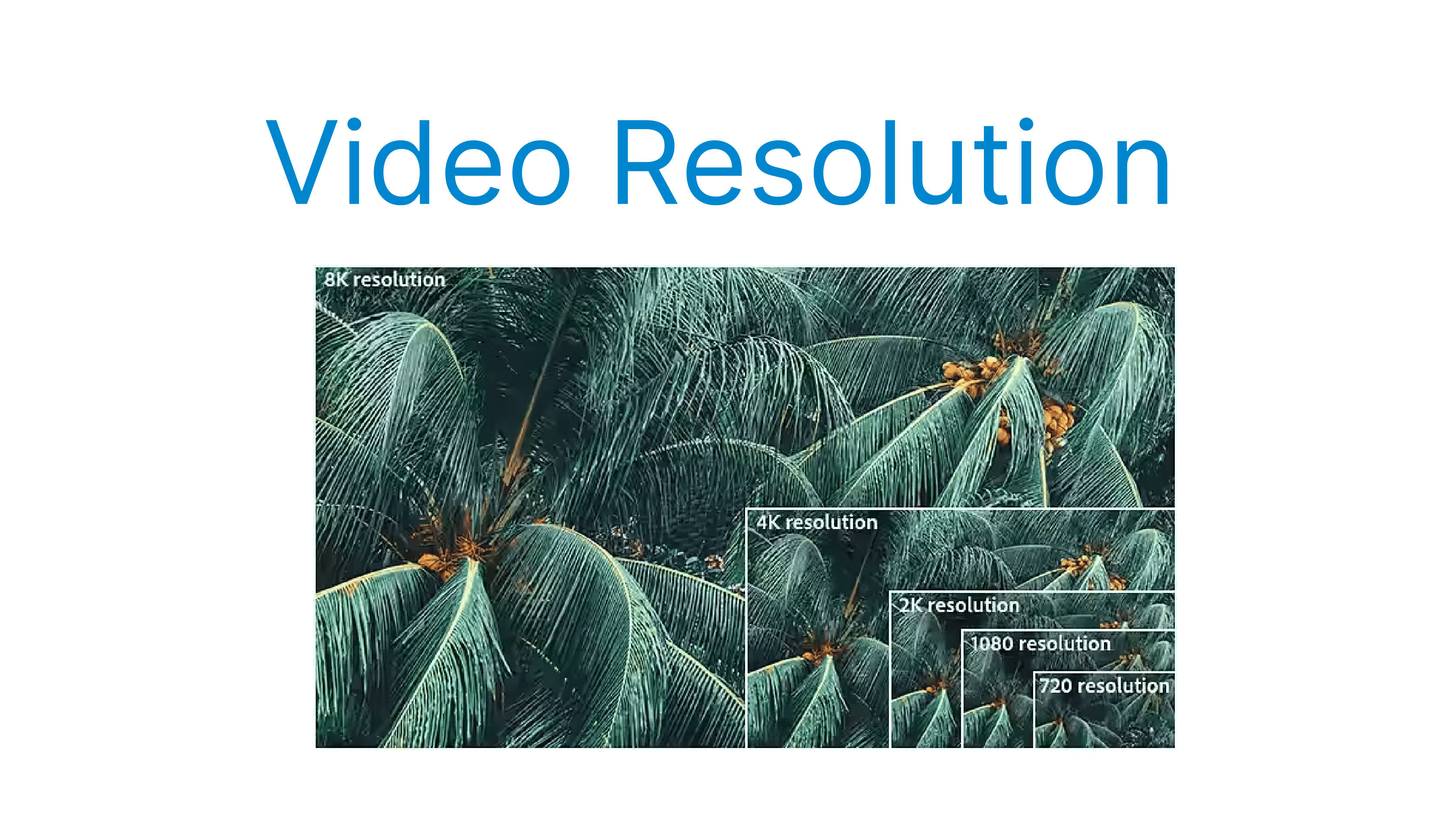
Video resolution defines the number of pixels used to display each frame, ultimately determining how sharp and detailed your video appears. From a development perspective, understanding screen resolution isn’t just about image quality but is crucial for encoding, rendering, and optimizing playback across devices and streaming platforms.
Standard Definition (SD)
Refers to a video encoded at a native resolution of 720 × 480 pixels (commonly labeled 480p) using a progressive scan format. It was the dominant video standard in the analog and early digital eras, primarily used for DVDs, standard broadcast television, and legacy video archives.
The resolution conforms to ITU-R BT.601, which governs color space and sampling for digital SD video. SD supports both 4:3 (native) and 16:9 (anamorphic) aspect ratios, using non-square pixels for widescreen content.
Exhibits limited spatial detail. When displayed on high-resolution screens, it suffers from noticeable blurring, lack of sharp edges, and compression artifacts, especially when upscaled.
Technical Characteristics
- Resolution: 720 × 480 (480p), progressive scan
- Aspect Ratio: 4:3 (legacy), 16:9 (anamorphic widescreen via pixel aspect ratio)
- Pixel Count per Frame: 345,600
- Frame Rate: 29.97 fps (NTSC), 25 fps (PAL)
- Color Sampling: 4:2:0 YUV in consumer formats (DVD); 4:2:2 in broadcast mastering
- Bit Depth: Commonly 8-bit per channel

Encoding Characteristics
SD content was historically encoded using the MPEG-2 (Part 2) codec.
- Bitrate Range (MPEG-2): 2–9 Mbps (DVD spec); typical streaming use: 1.5–3 Mbps
- GOP Structure: IPB or IBBP frames; fixed or adaptive Group of Pictures length
- Modern Re-encoding: Frequently re-encoded with H.264/AVC, which offers. Bitrate savings of up to 50% at equivalent quality
- Compression Efficiency: Low, due to the lack of modern features like motion vector prediction refinement and context-adaptive entropy coding
Development Considerations
Compression & Codec Transition
Legacy codecs like MPEG-2 offer poor compression efficiency by modern standards. Transitioning to modern codecs such as H.264 or H.265 ensures better compression rates and compatibility with web-based players and streaming protocols like HLS and DASH, enhancing overall video quality and delivery.
Upscaling Challenges
Standard upscaling methods like bilinear and bicubic scaling help increase video resolution, with bilinear being faster but less sharp and bicubic providing smoother gradients and better edge preservation. However, neither can recover lost detail, meaning the image quality still falls short of native high-resolution footage.
AI-based Super-Resolution
AI techniques like Real-ESRGAN can reconstruct high-frequency details, improving video quality by inferring missing data. While effective for offline remastering, these methods are computationally intensive and unsuitable for real-time processing without GPU support.
High Definition (HD)
Refers to a video encoded at a native resolution of 1280 × 720 pixels, commonly known as 720p, using a progressive scan format. HD resolution conforms to ITU-R BT.709, which defines the colorimetry and sampling used for HD content. It uses a square pixel grid and maintains a 16:9 aspect ratio natively, eliminating the need for non-square pixel correction seen in anamorphic SD formats.
Technical Characteristics
- Resolution: 1280 × 720 (720p), progressive scan
- Aspect Ratio: 16:9 (native, square pixels)
- Pixel Count per Frame: 921,600
- Bit Depth: Typically 8-bit for consumer content; 10-bit in professional environments
- Color Sampling: 4:2:0 YUV for consumer delivery; 4:2:2 or 4:4:4 for production pipelines
- Frame Rate: 23.976 / 24 / 25 / 29.97 / 30 / 50 / 59.94 / 60 fps (region and content dependent)
Encoding Characteristics
Encoded using H.264/AVC (MPEG-4 Part 10), which balances compression efficiency and visual fidelity. Earlier implementations used MPEG-2, especially in over-the-air and satellite broadcasts, but H.264 quickly became the industry standard for streaming and on-demand delivery.
- Bitrate Range (H.264): 1.5–5 Mbps for streaming; up to 8–10 Mbps for archival or Blu-ray quality
- GOP Structure: Long GOP with IPB frames; GOP size typically 60–120 frames (scene-change adaptive)
- Compression Efficiency: Moderate-to-high; ~2× more efficient than MPEG-2 at same visual quality
- Modern Usage: Frequently used as the baseline tier in ABR ladders for responsive adaptation across bandwidth conditions
- Entropy Coding: CABAC for high-efficiency modes; CAVLC for broader compatibility.
Development Considerations
Compression
Legacy codecs like MPEG-2 are still used in OTA TV and satellite systems, but they are less efficient compared to modern codecs. H.264 is widely supported, while VP9 and HEVC offer better compression at lower bitrates. For efficient streaming delivery, HD sources can be re-encoded using encoders like x264 or libvpx-vp9.
Scaling and Visual Fidelity
Upscaling to 1080p or 4K provides better scalability than SD resolution due to the higher native resolution. Bicubic scaling is commonly used for interpolation, offering acceptable quality, with edge sharpening often applied as a post-process. Visual quality remains sharp and motion is preserved on screens up to 32 inches, though artifacts may appear if the content is over-compressed.
Full High Definition (Full HD)
Refers to video encoded at a native resolution of 1920 × 1080 pixels, commonly labeled 1080p. Full HD maintains a 16:9 aspect ratio with square pixels and conforms to ITU-R BT.709 standards, which define its colorimetry and sampling structure. With over 2 million pixels per frame, Full HD offers significantly enhanced spatial detail, motion clarity, and image sharpness compared to 720p.
Technical Characteristics
- Resolution: 1920 × 1080 (1080p), progressive scan
- Aspect Ratio: 16:9 (native, square pixels)
- Pixel Count per Frame: 2,073,600
- Color Sampling: 4:2:0 YUV for consumer delivery; 4:2:2 or 4:4:4 in professional pipelines
- Bit Depth: Typically 8-bit for consumer formats; 10-bit in production workflows and HDR content
- Frame Rate: 23.976 / 24 / 25 / 29.97 / 30 / 50 / 59.94 / 60 fps (region-specific and content-dependent)
Encoding Characteristics
Full HD is predominantly encoded using H.264/AVC, which remains widely supported across hardware decoders, browsers, mobile devices, and TVs. In high-efficiency pipelines, HEVC (H.265) or VP9 may reduce file size while maintaining perceptual quality.
- Bitrate Range (H.264): 5–8 Mbps for streaming. 10–15 Mbps for Blu-ray or mezzanine content
- Bitrate Range (HEVC/VP9): 3–6 Mbps for equivalent quality to H.264
- GOP Structure: Scene-adaptive GOPs typically between 90–120 frames
- Entropy Coding: CABAC in H.264; HEVC uses advanced CTU (Coding Tree Unit) partitioning
- HDR Support: HDR10 and HLG are supported when encoded with 10-bit depth and appropriate metadata
- Streaming Formats: MP4 (H.264/AVC), WebM (VP9), HLS/DASH segment delivery with keyframe alignment
Development Considerations
Codec Selection
The primary codec for video delivery is H.264, offering maximum compatibility. For higher efficiency, VP9 and HEVC reduce bandwidth requirements by up to 50%. While AV1 adoption is growing, it is not yet the standard for 1080p across all platforms. For lossy-to-lossy compression, x264 and libvpx-vp9 are ideal, providing minimal visual degradation at controlled bitrates.
Scalability & Playback Optimization
Upscaling to 4K retains good quality when using methods like bicubic or edge-aware interpolation, but the visual clarity is optimal for screens up to 40-50 inches. On larger screens, the image may soften unless enhanced. Adaptive Streaming ensures smooth delivery, making it essential for 1080p streaming under bandwidth-constrained conditions, especially in ABR (Adaptive Bitrate) ladders.
4K Ultra High Definition (UHD)
Refers to video encoded at a native resolution of 3840 × 2160 pixels, often labeled as 2160p. It offers four times the pixel count of Full HD (1080p) and represents a significant leap in spatial fidelity, color depth, and compression requirements.
Defined under ITU-R BT.2020, 4K UHD introduces an expanded color gamut, increased bit depth, and enhanced frame rates, forming the backbone of modern cinematic, broadcast, and premium streaming pipelines.
The 4K resolution is delivered in a 16:9 aspect ratio using square pixels, making it compatible with consumer TVs, monitors, and streaming platforms without the need for scaling.
Technical Characteristics
- Resolution: 3840 × 2160 (2160p), progressive scan
- Aspect Ratio: 16:9 (native, square pixels)
- Pixel Count per Frame: 8,294,400
- Frame Rate: 23.976 / 24 / 25 / 29.97 / 30 / 50 / 59.94 / 60 fps
- Color Sampling:
✅ 4:2:0 for consumer streaming (AVC, HEVC, VP9, AV1)
✅ 4:2:2 or 4:4:4 for professional pipelines (ProRes, DNxHR, JPEG 2000)
- Bit Depth: 8-bit for SDR delivery. 10-bit for HDR delivery (HDR10, HDR10+, HLG, Dolby Vision)
- Color Gamut: Rec. 2020 (BT.2020), wider than Rec. 709
Encoding Characteristics
4K content is computationally intensive to encode and decode. Legacy codecs like H.264 are technically capable of 4K encoding but are inefficient at this scale.
Modern deployments primarily rely on HEVC (H.265), VP9, or AV1 to manage bitrate demands while maintaining perceptual quality.
- Bitrate Range:
✅ HEVC/VP9: 15–35 Mbps (streaming), 50–100 Mbps (archival/mastering)
✅ AV1: 10–30 Mbps for equivalent visual quality at lower bandwidth
- GOP Structure: Long GOP (e.g., 120–240 frames), hierarchical B-frame support. Scene-adaptive keyframe placement
- HDR Metadata: Static (HDR10) or dynamic (Dolby Vision, HDR10+) tone mapping metadata embedded in the stream
- Container Formats: MP4 (H.265), WebM (VP9), MKV (AV1), or TS for broadcast
- Delivery Profiles: DASH, HLS (fMP4) using segmented HTTP streaming with CMAF alignment
Development Considerations
Codec Selection
For modern video delivery, preferred codecs include HEVC (Main10), VP9 Profile 2, and AV1 (Main profile with 10-bit depth). While H.264 is technically compatible with 4K, it is rarely used due to inefficient compression and high decoding overhead. These codecs are typically placed at the top of ABR (Adaptive Bitrate) ladders, with fallback tiers like 1440p and 1080p for lower-quality resolutions.
For optimal performance, parallelized multi-pass encoding is recommended, with GPU acceleration (such as NVENC, Apple VideoToolbox, or Intel QSV) to reduce encoding time.
Playback & Device Compatibility
To ensure smooth playback, hardware acceleration is necessary on modern devices. Supported GPUs include NVIDIA Pascal and newer, AMD RDNA+, and Intel Gen 11+, along with Apple M1/M2. ARM-based chipsets (e.g., A14+, Snapdragon 855+) also support these codecs, including AV1.
Browser support includes VP9 on Chrome, Firefox, and Android WebView; AV1 on Chrome, Edge, and Firefox (hardware-dependent); and HEVC on Safari (macOS, iOS) and Windows 10+ (with the codec installed).
Bandwidth & Delivery
For 4K streaming, the recommended bandwidth for HEVC/VP9 is around 25 Mbps, while AV1 can deliver 4K at ~15 Mbps due to its efficient compression. Delivery infrastructure should support chunked transfer and low-latency HLS/DASH, with edge caching and prefetching to minimize buffer underruns.
The ABR strategy involves setting segment durations to 4s or 6s for a balance between switching granularity and stability, with keyframe alignment across renditions to enable seamless resolution switching.
8K Ultra High Definition (UHD)
Refers to video encoded at a native resolution of 7680 × 4320 pixels, also known as 4320p, using a progressive scan format. It offers four times the pixel count of 4K UHD and sixteen times that of Full HD (1080p).
This resolution is defined under ITU-R BT.2020 and is used in cutting-edge visual applications that demand ultra-fine detail, such as professional cinematography, digital signage, medical imaging, and high-end broadcasting.
Technical Characteristics
- Resolution: 7680 × 4320 (4320p), progressive scan
- Aspect Ratio: 16:9 (native, square pixels)
- Pixel Count per Frame: 33,177,600
- Frame Rate: 24/30/60/120 fps supported in BT.2020
- Color Sampling:
✅ 4:2:0 for consumer streaming (AV1, HEVC)
✅ 4:2:2 and 4:4:4 in production/mastering pipelines (e.g., JPEG 2000, ProRes RAW)
- Bit Depth: 10-bit minimum for HDR support. 12-bit used in specialized workflows (HDR mastering, DCI-P3/BT.2020 wide color)
- Color Gamut: Rec. 2020 (BT.2020), required for true 8K workflows
Encoding Characteristics
Due to the massive data volume, 8K content must use next-generation codecs with advanced compression algorithms. AV1 and HEVC (Main10 and Main12) are most commonly used, with VVC (H.266) emerging for high-efficiency commercial deployment.
- Bitrate Range:
✅ AV1/HEVC: 80–200 Mbps for high-fidelity VOD
✅ Production ProRes 8K: >500 Mbps to multi-gigabit range (intra-frame codecs)
- GOP Structure
✅ Long GOPs (up to 240 frames), often with hierarchical B-frames
✅ Scene-adaptive I-frame spacing and motion vector reuse critical for efficiency
- Entropy Coding: CABAC (HEVC), binary arithmetic coding (AV1), with improved prediction trees in VVC
- HDR Metadata: Static (HDR10) and dynamic (HDR10+, Dolby Vision) supported; PQ transfer function commonly used
- Delivery Format: Segment-based streaming (DASH, HLS with CMAF), master files in IMF or MXF for studio use
Development Considerations
Codec Selection & Performance
AV1 is the most efficient open-source codec, with hardware acceleration on newer devices. HEVC Main10 offers broad compatibility but is less efficient than AV1. VVC (H.266) is emerging for ultra-HD, though not widely supported.
Efficient encoding requires multi-threaded or GPU-accelerated tools (e.g., SVT-AV1, x265) and can take 10–20x real-time for 8K at high bitrates.
Hardware & Decoder Requirements
For decoding, NVIDIA RTX 30/40, AMD RDNA2+, and Apple M1/M2 GPUs are supported, along with ARM chips like Google Tensor G3 and A17 Bionic. Edge devices like 8K TVs from Samsung, LG, and Sony support HEVC/AV1. AV1 works in Chrome, Firefox, and Edge, while HEVC requires installation on Windows. For smooth 8K playback, 2–4 GB RAM and 300 MB/s+ SSD speeds are needed.
Network Infrastructure
80 Mbps is the minimum for AV1 streaming at medium fidelity, with 100–150 Mbps recommended for high-quality 8K with HDR. For low-latency playback, a 2–4 s segment duration is ideal, supported by edge caching and chunk prefetching. ABR profiles should include 4K. 1440p and 1080p, and adaptive buffers should prefetch for ≥10s to minimize buffering. LL-HLS and LL-DASH protocols should be optimized for efficient delivery.
What's Next?
Want to support SD to 8K video resolutions in your encoding or streaming pipeline? Use Cincopa’s API to handle multi-resolution video processing, adaptive bitrate streaming, and efficient compression with modern codecs like H.264, HEVC, and AV1.
Explore our developer documentation to implement resolution-aware workflows with optimized performance across devices