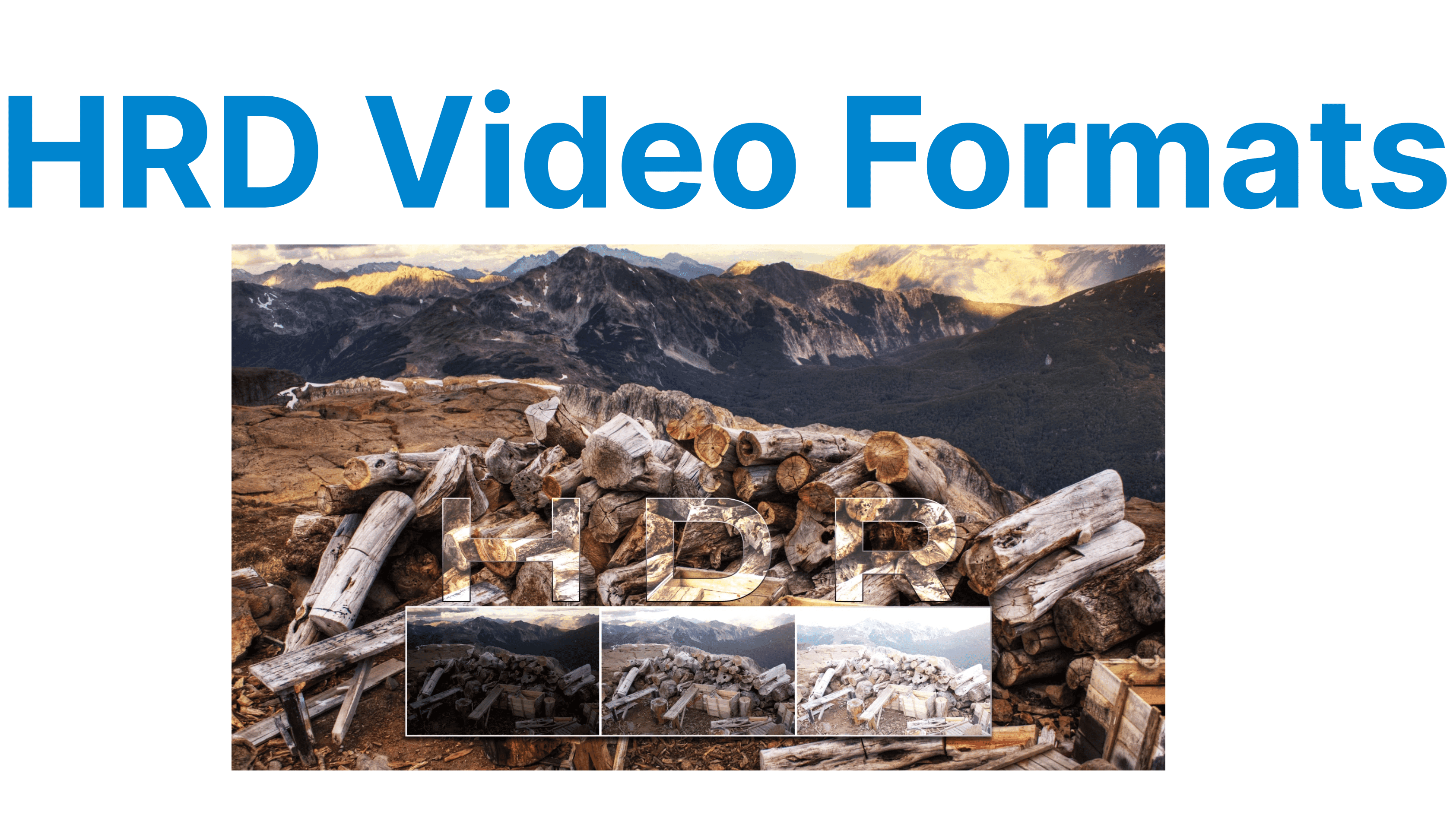
High Dynamic Range (HDR) formats represent a major advancement in video quality, offering extended contrast ratios, wider color gamuts, and more nuanced gradations in brightness and shadow. For developers and engineers building streaming platforms, encoding pipelines, or video playback engines, understanding the technical distinctions between the leading HDR formats"HDR10, Dolby Vision, and Hybrid Log-Gamma (HLG)"is critical to ensuring compatibility, perceptual quality, and system efficiency.
HDR10
HDR10 is an open, industry-standard HDR format defined by the Consumer Technology Association (CTA). It is widely supported in UHD Blu-ray, digital cinema, OTT streaming platforms (e.g., Netflix, Prime Video), and console gaming. Its key limitation is the use of static metadata, which applies one set of tone-mapping instructions to the entire video.
Technical Details
- Metadata: Static (SMPTE ST 2086, MaxFALL, MaxCLL)
- Bit Depth: 10-bit
- Color Space: Rec. 2020
- EOTF (Electro-Optical Transfer Function): PQ (SMPTE ST 2084)
- Brightness Mastering Target: Typically 1,000 nits (up to 4,000 nits supported)
- SDR Compatibility: Not backward-compatible
- Licensing: Royalty-free
Developer Insight
The absence of scene-adaptive metadata means tone mapping behavior is fixed at encode time. This can result in crushed blacks or blown-out highlights on displays with differing brightness capabilities. Still, HDR10"s simplicity and broad hardware support make it a reliable baseline format.
Dolby Vision
Dolby Vision is a premium HDR format developed by Dolby Laboratories. It uses dynamic metadata to adjust tone mapping per scene or per frame, ensuring optimal visual output across different content types and display capabilities. Dolby Vision supports up to 12-bit color depth, enabling smoother gradients and greater precision in high-brightness areas.
Technical Details
- Metadata: Dynamic (per scene or frame), plus a static base layer
- Bit Depth: Up to 12-bit (supports 10-bit fallback)
- Color Space: Rec. 2020
- EOTF: PQ (SMPTE ST 2084)
- Brightness Mastering Target: Up to 10,000 nits
- SDR Compatibility: Yes, via an optional HDR10 base layer
- Licensing: Requires Dolby certification and license
Developer Insight
Dolby Vision"s metadata stream is standardized under SMPTE ST 2094-10 and enables content-specific optimization. Implementing Dolby Vision requires compliance with strict Dolby toolchains and test suites, making it ideal for high-end production workflows where image consistency and color grading precision are paramount.
Hybrid Log-Gamma (HLG)
HLG is a backward-compatible HDR format co-developed by the BBC and NHK, designed for live and broadcast scenarios. Unlike HDR10 and Dolby Vision, HLG uses no metadata. Instead, it employs a hybrid EOTF that combines gamma for low-luminance regions with a logarithmic function for highlights, making it display-adaptive.
Technical Details:
- Metadata: None
- Bit Depth: 10-bit
- Color Space: Rec. 2020
- EOTF: Hybrid Log-Gamma curve
- Brightness Mastering Target: No fixed target (display-adaptive)
- SDR Compatibility: Yes (backward-compatible)
- Licensing: Open and royalty-free
Developer Insight
HLG is preferred for broadcast or low-latency workflows, where dynamic metadata insertion is infeasible. However, due to its display-dependent tone mapping and absence of scene-specific metadata, image accuracy varies across devices.
Use Case Considerations
HDR10
Best for platforms needing wide device support, fixed encoding parameters, and lower complexity. Ideal for physical media and baseline streaming support.
Dolby Vision
Suited for high-end content delivery where per-scene optimization, 12-bit color precision, and future-proof mastering are priorities.
HLG
Optimal for live television, sports, or hybrid delivery to mixed HDR/SDR audiences, especially when latency and broadcast simplicity matter.
Comparison Table
| Feature | HDR10 | Dolby Vision | HLG |
| Metadata | Static | Dynamic (frame/scene) | None |
| Bit Depth | 10-bit | Up to 12-bit | 10-bit |
| Color Space | Rec. 2020 | Rec. 2020 | Rec. 2020 |
| EOTF | PQ (ST 2084) | PQ (ST 2084) | Hybrid Log-Gamma |
| Brightness | Target 1,000"4,000 nits | Up to 10,000 nits | Display-adaptive |
| SDR Compatibility | No | With base layer (optional) | Yes |
| Licensing | Royalty-free | Licensed by Dolby | Royalty-free |
| Use Case Suitability | Streaming, Discs, Consoles | High-end, streaming, Blu-ray | Live broadcast, hybrid feed |