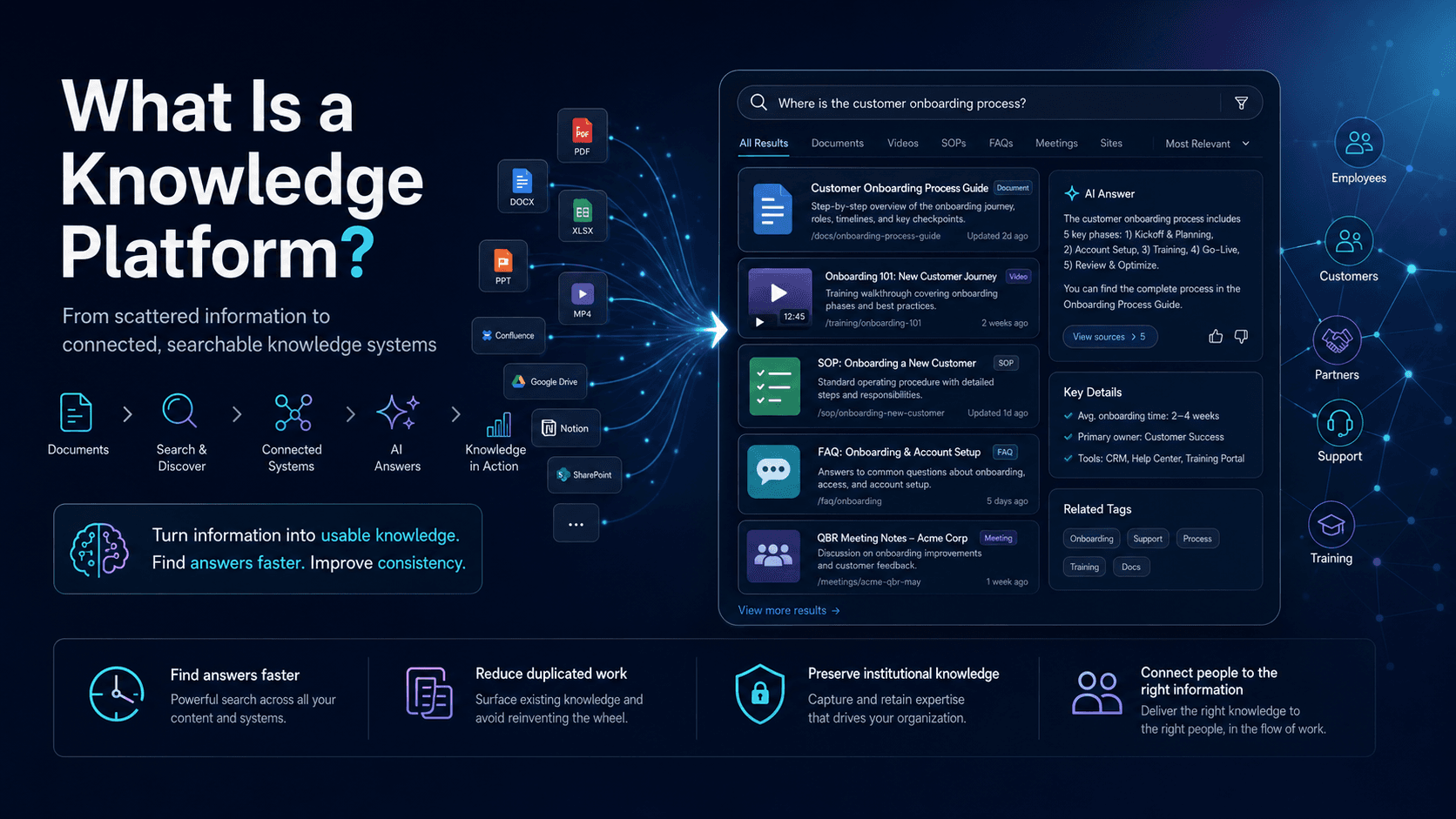
Every organization runs on knowledge.
Employees need it to do their jobs. Customers need it to learn about products. Partners need it to understand processes. Support teams need it to solve problems. Yet despite its importance, knowledge is often scattered across dozens of systems.
Some information lives in documents. Some sits inside knowledge bases. Training materials may be stored in learning platforms. Meeting recordings are buried in shared drives. Product walkthroughs, webinars, and support videos are spread across video libraries, help centers, and collaboration tools.
As organizations grow, finding information often becomes harder than creating it.
This challenge has given rise to a category of software known as knowledge platforms.
What Is a Knowledge Platform?
A knowledge platform is a system designed to help organizations organize, distribute, discover, and retrieve information.
Unlike a simple file repository, a knowledge platform focuses on making knowledge usable. The goal is not simply to store information but to help people find the right answer when they need it.
A well-designed knowledge platform creates a structured environment where information can be shared across teams, departments, customers, and partners. It helps reduce duplicated work, improve consistency, accelerate learning, and preserve institutional knowledge that might otherwise be lost.
At its core, a knowledge platform exists to bridge the gap between information and action.
Why Knowledge Platforms Have Become Essential
Modern organizations create an enormous amount of content.
Product teams publish documentation. Training teams create learning materials. Support teams develop troubleshooting resources. Operations teams document procedures. Employees generate meeting recordings, presentations, and process walkthroughs every day.
The challenge is that knowledge rarely stays in one place.
Over time, organizations accumulate information across shared drives, collaboration tools, intranets, learning systems, document repositories, support portals, and video platforms. While each system serves a purpose, the overall experience often becomes fragmented.
As a result, employees spend time searching instead of working. Customers submit support requests for questions that have already been answered. New hires struggle to find training materials. Teams repeatedly solve problems that someone else has already documented.
Knowledge platforms emerged to address this problem by creating a more unified approach to knowledge management and retrieval.
The Shift from Browsing to Asking
For years, knowledge systems were built around browsing.
Users were expected to navigate folders, search documentation, open articles, and manually piece together answers. This approach worked when information volumes were relatively small.
Today, the amount of organizational knowledge has grown beyond what most people can reasonably navigate.
At the same time, artificial intelligence has changed user expectations.
People have become accustomed to asking questions in natural language and receiving direct answers. Instead of searching through dozens of pages, they expect systems to understand intent, retrieve relevant information, and present answers immediately.
This shift is changing the role of knowledge platforms.
Increasingly, knowledge platforms are evolving from places people browse into systems people can question.
The focus is moving away from storage and toward retrieval.
Different Types of Knowledge Platforms
The term "knowledge platform" covers a broad range of solutions.
Some platforms focus on internal documentation and collaboration. Others are designed for customer support and self-service knowledge delivery. Learning management systems help organizations deliver structured training programs, while enterprise search platforms connect information across multiple repositories.
Although these systems serve different purposes, they all address the same challenge: helping people access knowledge when they need it.
What is changing today is not the goal of these platforms, but the type of content they must manage.
Knowledge is no longer created primarily in documents.
Increasingly, it is created in video.
The Growing Problem with Video Knowledge
Over the past decade, organizations have dramatically increased their use of video.
Training sessions are recorded. Product demonstrations are captured on screen. Webinars are archived. Customer onboarding sessions are stored for future use. Internal meetings are automatically recorded and shared.
For many organizations, some of the most valuable knowledge now exists in video format.
Video is often more effective than written documentation because it shows processes visually and captures context that text alone may miss. However, video introduces a new challenge.
It is difficult to search.
A thirty-minute training session may contain dozens of valuable answers, but finding a specific answer often requires manually watching large portions of the recording. Even when transcripts exist, organizations often lack an efficient way to transform recordings into usable knowledge assets.
As video libraries continue to grow, knowledge is no longer trapped only in documents.
It is increasingly trapped inside recordings.
The Emergence of Video Knowledge Platforms
This challenge has led to the emergence of a newer category: Video Knowledge Platforms.
A Video Knowledge Platform treats video as a knowledge asset rather than a media file.
Instead of focusing exclusively on hosting and playback, these platforms help organizations organize, distribute, search, retrieve, and improve knowledge contained within videos.
The goal is to move beyond passive viewing experiences and make video content behave more like an active knowledge system.
Rather than asking users to browse playlists or manually search through recordings, a Video Knowledge Platform helps them retrieve specific answers from the content itself.
In many ways, this represents the next evolution of knowledge management.
How Organizations Are Approaching Video Knowledge
Different vendors are approaching this challenge from different directions.
Some platforms focus on enterprise video management and learning environments. Others focus on lecture capture, training delivery, enterprise search, or AI-powered retrieval.
For example, Panopto positions itself as a Video Knowledge Platform focused on searchable video libraries, learning experiences, lecture capture, and institutional knowledge preservation.
Other platforms are exploring how video can become part of broader operational knowledge systems that connect training, support, onboarding, documentation, and workflow guidance.
What these approaches share is a common belief: video should not be treated as isolated media. It should be treated as searchable organizational knowledge.
How Cincopa Approaches Video Knowledge
One example of this emerging approach is Cincopa.
Rather than treating videos as standalone assets, Cincopa organizes videos, documents, training materials, and recorded expertise into structured knowledge environments.
Through Galleries, Pages, and CincoTube, organizations can build dedicated experiences for product education, support, onboarding, partner enablement, and internal knowledge sharing. Instead of creating disconnected video libraries, teams can organize content around specific audiences, workflows, and business objectives.
VideoGPT extends this approach by allowing users to ask questions across videos and related documents using natural language. Rather than searching manually, users can receive direct answers and navigate to the exact moment within a video where the answer appears.
The result is a shift from content consumption to knowledge retrieval.
The Future of Knowledge Platforms
The future of knowledge management is unlikely to be text-only or video-only.
Organizations increasingly create knowledge in many formats, including documents, videos, presentations, recordings, PDFs, and collaborative content. The challenge is not choosing one format over another. The challenge is making all of that knowledge accessible through a unified experience.
As artificial intelligence continues to improve retrieval and discovery, knowledge platforms will become less focused on storage and more focused on answers.
The organizations that succeed will not necessarily be the ones that create the most content. They will be the ones that make their knowledge easiest to access, understand, and use.
That shift is already underway, and Video Knowledge Platforms represent an important part of the next generation of knowledge systems.