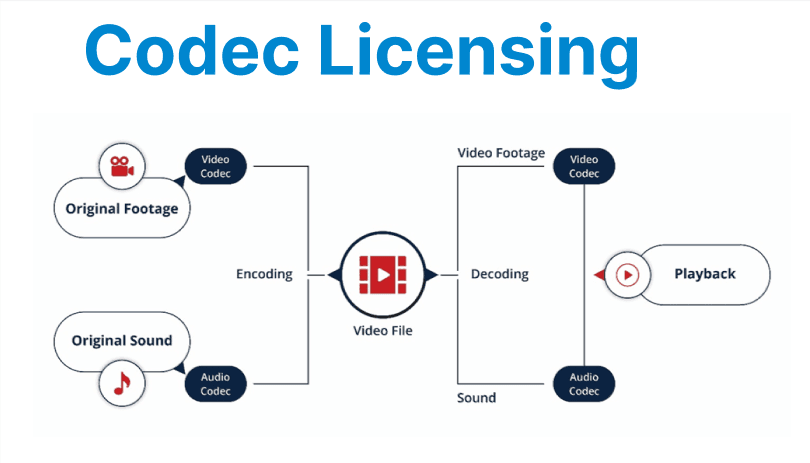
Codec licensing and royalties are key considerations when working with video compression technologies, especially in streaming, video-on-demand (VOD), and content distribution. Proprietary codecs such as H.264 and HEVC come with licensing fees, while open-source codecs like VP9 and AV1 are royalty-free.
Understanding the implications of licensing models is important for developers to avoid legal complications and manage costs effectively, especially when scaling applications.
Understanding Codec Licensing Models
Proprietary Codecs: Licensing and Royalties
Proprietary video codecs like H.264 (AVC) and HEVC (H.265) are based on patented technologies, which require developers to pay licensing fees. These fees are typically charged by the patent holders or licensing administrators, such as MPEG LA for H.264 and HEVC.
- H.264: A widely used codec for streaming and physical media distribution, H.264 requires licensing for video encoding and decoding. Typically, licensing fees are charged per unit sold or per usage (e.g., per stream, per device).
- HEVC: HEVC offers higher compression efficiency than H.264 but has a more complicated licensing model. Multiple patent pools are involved, and licensing fees can be significant, particularly for large-scale deployments.
For developers, understanding how licensing fees are structured—whether they're based on per unit, per device, or per stream—is essential for budgeting and cost planning.
Open-Source Codecs: Alternatives to Proprietary Models
Open-source codecs like VP9 and AV1 offer royalty-free alternatives to proprietary codecs. These codecs are developed and maintained by organizations like Google (VP9) and the Alliance for Open Media (AV1), and do not require licensing fees.
- VP9: Developed by Google, VP9 is an open-source codec that competes with HEVC. It offers similar compression efficiency to HEVC, but without licensing fees. However, its adoption is limited on older devices and platforms.
- AV1: AV1 is a newer codec designed to outperform VP9 and HEVC in terms of compression efficiency. It is royalty-free and supported by major tech companies. AV1 is suitable for high-resolution streaming and large-scale video distribution.
While open-source codecs avoid licensing fees, they may still have limitations regarding hardware support and computational demands, particularly for real-time encoding.

Licensing Terms and Commercial Use
Commercial Use Cases: Impact of Licensing Fees
For businesses deploying video encoding, streaming, or distribution systems, codec licensing fees can significantly impact operational costs. Proprietary codecs like H.264 or HEVC often require payments based on the number of units distributed or the number of streams delivered.
- Streaming services, for example, may incur fees for each user session or stream.
- Content distributors may need to pay licensing fees for each DVD, Blu-ray, or VOD delivery.
On the other hand, using open-source codecs like VP9 or AV1 can eliminate licensing costs, but may require more processing power for encoding and decoding, which could affect performance and cost efficiency.
Licensing Agreements and Patent Pools
For proprietary codecs, licensing is often managed through patent pools, where multiple patent holders consolidate their patents and require developers to pay a collective fee. These patent pools are managed by organizations such as:
- MPEG LA: This organization handles licensing for H.264 and HEVC.
- HEVC Advance: Another patent pool for HEVC licensing.
These licensing pools simplify the process for developers, but the fees can vary based on usage and region.
Key Considerations for Developers
When developing an application that uses video codecs, there are several factors to consider:
- Determine Your Codec Usage: Understand whether your application will stream, encode, or decode video, as licensing terms can vary for each case.
- Choose the Right Codec for Your Project: Evaluate the trade-offs between licensing fees and codec performance. For instance, H.264 is widely supported, but AV1 offers better compression at no cost.
- Review Licensing Terms: Always check the licensing structure of the codec you plan to use, especially for commercial applications. Ensure that you're clear on per-unit, per-stream, or per-device costs.
- Fallback Strategies: In some cases, it may be beneficial to implement fallback codecs based on device or browser compatibility. For example, use H.264 as a fallback if AV1 is not supported.